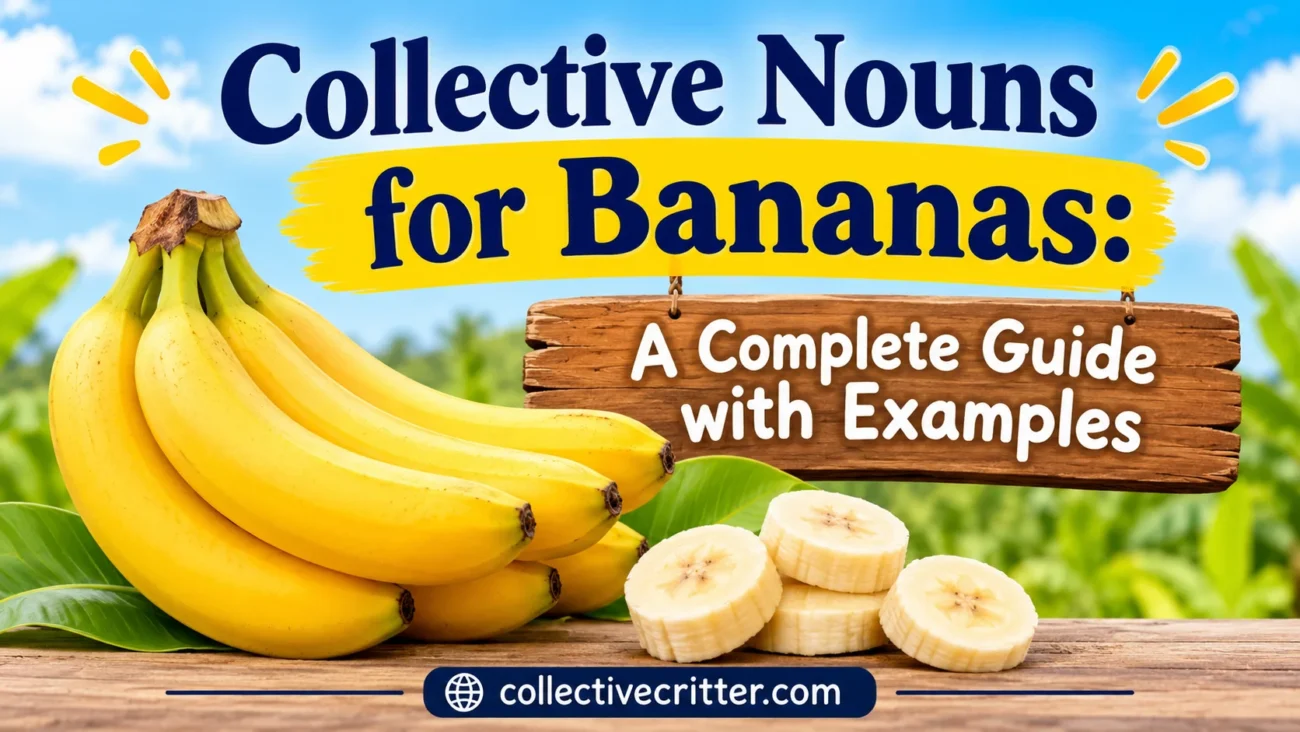
A collective noun for bananas helps you describe groups of this familiar fruit clearly in everyday English. The expressions bunch, hand, and cluster each describe a particular way bananas are connected or grouped. For example, a bunch of bananas usually refers to a larger group, while a hand of bananas describes a smaller group of individual fruits attached together. A cluster of bananas can describe fruits growing or gathered close to one another. These terms make fruit descriptions more precise and help improve your English vocabulary.
You can use these collective expressions in different situations, including grocery shopping, food descriptions, and everyday conversations. For example, you might buy a bunch of bananas at a grocery store, place a hand of bananas in a fruit basket, or see a cluster of bananas hanging from a banana plant. These expressions are also useful in agriculture, banana cultivation, harvesting, and transportation. After harvesting, bananas are often arranged, stored, displayed, and packed before they reach a fruit market. Learning these practical examples makes collective noun usage easier to understand.
Bananas have interesting physical characteristics, nutritional value, and a long history. They grow in groups on plants, forming natural arrangements that are commonly described as bunches and hands. Their growth, fruit production, storage, and distribution are important parts of banana cultivation and the food industry. Understanding these details can also improve your food vocabulary and descriptive language. When you learn the meanings of these common expressions through simple example sentences, you can describe individual fruits and larger groups more naturally in English.
1.Why Are Collective Nouns Used for Bananas?
Collective nouns and grouping expressions help describe several bananas as one recognizable collection. Instead of mentioning every individual fruit, we can use a suitable expression to explain how bananas are connected, arranged, or presented.
Bananas naturally grow in groups on large flowering plants. These groups have specific names in agriculture and everyday English. A bunch generally refers to a large group of bananas, while a hand describes a smaller group of bananas attached to the same central stalk. Individual bananas are sometimes called fingers.
Understanding these terms is helpful when buying bananas, discussing fruit production, preparing food, or describing tropical plants. It also makes English sentences more precise and informative.
2.Collective Nouns for Bananas
Several collective expressions are used for bananas, depending on their arrangement and context. The following table introduces some common and descriptive terms.
| Collective Noun | Type or Use | Simple Example |
| Bunch | A large group of bananas | A bunch of bananas hung from the plant. |
| Hand | A smaller group of attached bananas | A hand of bananas was on the counter. |
| Cluster | Several bananas growing or grouped together | A cluster of bananas looked fresh. |
| Comb | A group of bananas attached to a central stalk | A comb of bananas was harvested. |
| Stem | The central stalk carrying banana hands | The stem held several banana hands. |
| Bundle | Bananas gathered together for handling | A bundle of bananas was delivered. |
| Bunches | Multiple groups of bananas | Several bunches of bananas were displayed. |
Note: Bunch, hand, and cluster are useful everyday expressions. In banana cultivation, hand and finger are more specific agricultural terms. Comb and stem are also used when describing banana bunch structure.
3.A Bunch of Bananas
A bunch of bananas is the most familiar collective expression for bananas. It describes a large group of bananas growing together on a banana plant or collected for selling and transportation. A bunch may contain several smaller groups called hands, with each hand containing multiple individual bananas.
This expression is commonly used in grocery shopping, fruit markets, kitchens, and everyday conversations. It is also a natural choice when describing bananas hanging from a plant.
Examples of “A Bunch of Bananas”
- A bunch of bananas were hanging from the tree.
- My mother bought a bunch of bananas from the market.
- He placed a bunch of bananas on the kitchen table.
- The farmer harvested a fresh bunch of bananas.
- A bunch of bananas were displayed in the fruit shop.
- She used a bunch of bananas to prepare a dessert.
- The children shared a bunch of bananas after lunch.
- We saw a large bunch of bananas in the garden.
- A bunch of bananas were packed for delivery.
- The shopkeeper weighed a bunch of bananas for the customer.
4.A Hand of Bananas
A hand of bananas refers to a smaller group of bananas attached together along the central stalk of a larger bunch. In banana agriculture, each individual banana is commonly called a finger, while a group of fingers forms a hand.
This expression is particularly useful when discussing banana harvesting, sorting, packaging, and selling. It helps distinguish a smaller group of bananas from the entire bunch.
Examples of “A Hand of Bananas”
- A hand of bananas was placed inside the basket.
- The farmer separated a hand of bananas from the bunch.
- She bought a hand of bananas from the fruit seller.
- A fresh hand of bananas was hanging from the stalk.
- He selected a ripe hand of bananas for breakfast.
- The worker carefully packed a hand of bananas.
- A hand of bananas was resting on the counter.
- My grandmother gave me a hand of bananas.
- The shopkeeper displayed a hand of bananas near the entrance.
- We examined a hand of bananas before purchasing it.
5.A Cluster of Bananas
A cluster of bananas describes several bananas growing or gathered closely together. This expression is useful when emphasizing the grouped arrangement of the fruits rather than their exact agricultural structure.
Clusters can be observed on banana plants as the fruits develop around the central stalk. The term is also suitable for describing bananas arranged closely together in markets, baskets, or storage areas.
Examples of “A Cluster of Bananas”
- A cluster of bananas was growing on the plant.
- The farmer inspected a cluster of bananas carefully.
- A ripe cluster of bananas was ready for harvesting.
- We noticed a cluster of bananas in the garden.
- The worker carried a cluster of bananas to the storage room.
- A cluster of bananas was displayed at the fruit market.
- She selected a cluster of fresh bananas.
- The photograph showed a beautiful cluster of bananas.
- A cluster of bananas was hanging from the central stalk.
- The children admired the large cluster of bananas.
6.A Comb of Bananas
A comb of bananas is an expression used in banana-growing terminology to describe a group of bananas attached together along the main stalk. It is closely associated with the agricultural description of banana bunches and their individual hands.
This term is less familiar in everyday conversation than bunch or hand, but it can be useful when discussing banana cultivation, harvesting, and the arrangement of fruits on a plant.
Examples of “A Comb of Bananas”
- A comb of bananas was removed from the plant.
- The farmer examined the comb of bananas before harvesting.
- A fresh comb of bananas was placed in the basket.
- The workers carried a comb of bananas to the packing area.
- She noticed a comb of bananas hanging from the stalk.
- The comb of bananas contained several healthy fruits.
- The farmer carefully selected a comb of bananas.
- A comb of bananas was displayed at the agricultural exhibition.
- The worker packed the comb of bananas for transportation.
- We learned how a comb of bananas develops on the plant.
7.Interesting Facts About Bananas
Bananas are among the most widely consumed fruits in the world and have a history that stretches back thousands of years. They are believed to have originated in Southeast Asia and the surrounding tropical regions before spreading to Africa, the Middle East, and other parts of the world. Today, bananas are cultivated in many tropical and subtropical countries. Interestingly, the banana plant is not technically a tree but a large herbaceous flowering plant because it does not develop a traditional woody trunk.
Bananas are also valued for their nutritional benefits. They contain carbohydrates, natural sugars, dietary fibre, potassium, and vitamin B. Their energy content makes them a popular snack among athletes, students, and people with busy lifestyles. Bananas can be eaten fresh or used in smoothies, cakes, desserts, breakfast dishes, and other recipes. Another interesting fact is that bananas continue to ripen after harvesting. As they ripen, their green peel gradually changes to yellow, and their texture becomes softer and sweeter.
Conclusion
Understanding the collective noun for bananas makes it easier to describe how bananas are grouped in everyday situations. The most common expressions are a bunch of bananas, a hand of bananas, and a cluster of bananas. Each expression describes a different type of grouping, whether bananas are growing on a plant, displayed in a grocery store, or placed in a fruit basket. Learning these terms improves your English vocabulary and helps you use clear, natural descriptions in everyday conversations.
FAQs
Q1. What is the most common collective noun for bananas?
The most common collective noun for bananas is a bunch of bananas. It describes a group of bananas growing together or collected for selling and transportation.
Q2. What is a hand of bananas?
A hand of bananas is a smaller group of individual bananas attached together along the central stalk of a larger bunch.
Q3. What is an individual banana called?
An individual banana is commonly called a finger in banana-growing terminology. Several fingers attached together form a hand.
Q4. Is “a cluster of bananas” correct?
Yes, a cluster of bananas is a correct expression. It describes several bananas growing or arranged closely together.
Q5. What is a comb of bananas?
A comb of bananas is an agricultural expression used for a group of bananas attached together along the main stalk.
Q6. What is the difference between a bunch and a hand of bananas?
A bunch is the larger grouping of bananas, while a hand is one of the smaller groups attached to the bunch. A hand generally contains several individual fingers.
Q7. Can I say “a group of bananas”?
Yes, a group of bananas is grammatically correct. It is a general expression that can describe bananas gathered together in any arrangement.

